

Learn about Metropolitan Nashville Airport Authority including our News & Press Releases, BNA Vision and New Horizon Capital Development Program, and Team.
Talk to us
Have questions? Reach out to us directly.
Learn about Metropolitan Nashville Airport Authority including our News & Press Releases, BNA Vision and New Horizon Capital Development Program, and Team.
About Metropolitan Nashville Airport Authority
- FY2025 Total Passengers
- 24.8 million
- Senior Bond Ratings
- A1/A+/AA-
- FY2025 Ending Outstanding Debt
- $2.0 billion
Since 1970, The Metropolitan Nashville Airport Authority (the “Authority”) has owned and operated Nashville International Airport (the Airport or BNA) and John C. Tune Airport (JWN), a general aviation reliever airport. The Authority is a self-financing entity and uses no local tax dollars.
To generate needed revenue, the Authority collects fees, rents and other charges from users such as airlines, car rental companies and concessionaires. Air travelers also contribute through passenger facility charges and parking fees.
To ensure its financial viability, the Authority entered into a new Signatory Airline Use and Lease agreement (the agreement) effective July 1, 2023. The Agreement has an eight-year term with one two-year mutual renewal. Highlights of the agreement include:
- Annual Minimum Signatory Airline Commitment: Passenger carriers must pay at least 1% of the total rates, charges, and fees paid by all signatory airlines. Cargo carriers must pay at least 1% of annual landing fees paid by all signatory airlines.
- Landing fee methodology remains residual.
- The terminal rate methodology changes to commercial compensatory with a 50% airline rented space minimum if certain debt service coverage requirements are not met.
- Rolling debt service coverage is incorporated in all rate calculations for airline cost centers.
- Signatory airline support for John C. Tune airport continues.
Image Gallery
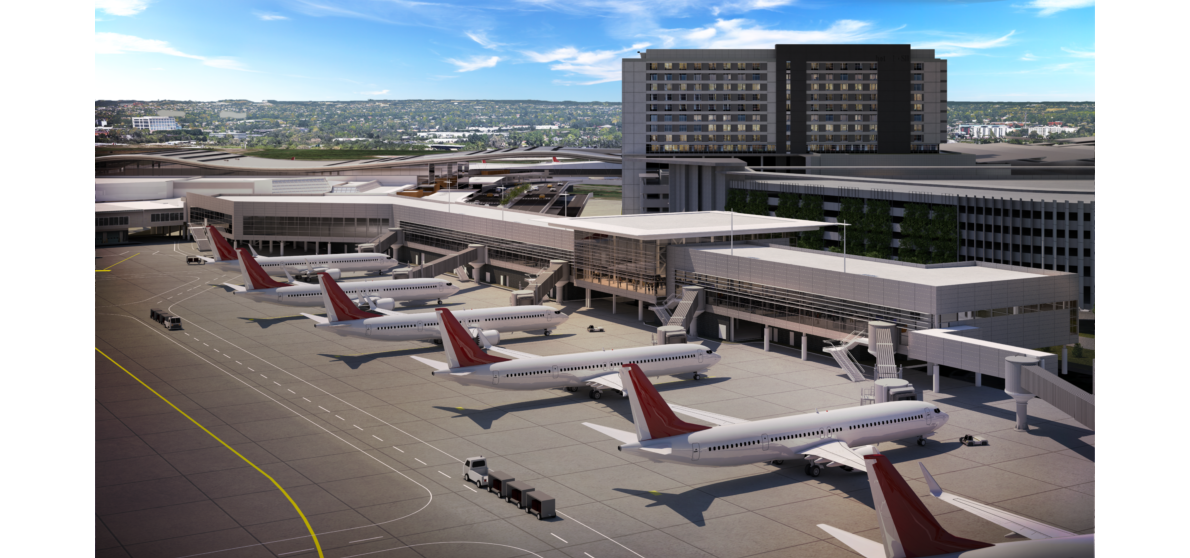
News
|
|---|
Nashville, Tenn. (Oct. 14, 2026) – Nashville International Airport®, also known as BNA®, and Air France today officially announced the launch of a new nonstop international air service between Nashville and Paris–Charles de Gaulle Airport (CDG), beginning May 14, 2027.
A state-of-the-art Airbus A350-900 will operate this route three times weekly on Mondays, Wednesdays and Fridays. The flight time is just under 9.5 hours. As a tribute to Dolly Parton, flights between Paris and Music City will carry the flight number AF046—a nod to 1946, the year Parton was born. The service will offer seamless onward connections through Paris‑CDG to major destinations across Europe, Africa, the Middle East and Asia. The service will provide Middle Tennessee travelers with a direct gateway to one of the world’s most iconic cities and the global Air France network.
“Today marks an exciting milestone for BNA and Music City as we welcome Air France and a new nonstop connection to Paris, France,” said Doug Kreulen, president and CEO of the Metropolitan Nashville Airport Authority (MNAA). “This route will provide Middle Tennesseans with new opportunities to experience Europe and beyond, while further elevating Nashville’s presence on the global stage. It’s another important step in our commitment to serve a rapidly growing, globally connected region.”
This new route will significantly enhance Nashville’s access to Europe and beyond. Paris, renowned for landmarks such as the Eiffel Tower, the Louvre, Notre‑Dame Cathedral, and its storied culinary and artistic heritage, offers visitors an unforgettable urban experience. CDG also serves as one of Europe’s busiest international hubs, providing convenient connections to more than 300 destinations worldwide. Nashville will be Air France’s 20th destination in the United States, and the new service will also allow for easy connections with its joint venture partner Delta Air Lines.
“We are delighted to bring Air France to Nashville for the first time. As a dynamic city with a distinctive cultural identity and growing international appeal, Nashville represents an exciting addition to our U.S. network. This new nonstop connection to Paris will make it easier for Tennesseans to visit Paris, Europe, and beyond, offering them the best of French elegance from the moment the journey starts.” - Nicolas Hénin, Senior Vice President, North America, Air France-KLM
Travelers visiting France can explore Paris’s world‑class museums, historic neighborhoods, vibrant dining scene, and picturesque Seine riverfront. Beyond the capital, regions such as Provence, Normandy, the Loire Valley, and the French Riviera offer extraordinary opportunities for cultural, outdoor, and gastronomic exploration. For those continuing farther afield, Paris‑CDG provides one of the most efficient gateways for global travel.
The Nashville–Paris connection will enhance Nashville’s international profile and provide Middle Tennesseans with new opportunities to explore Europe and destinations around the world, further strengthening BNA’s expanding portfolio of international nonstop routes.
For more information about Air France or to book travel, please visit airfrance.us.
|
|
|---|
____________________________________________________________________________________
About Air France
Since 1933, Air France has proudly represented France across the globe. With expertise spanning passenger air transport, cargo, and aircraft maintenance and engineering, Air France is a major player in the aviation sector. More than 40,000 employees are committed each day to delivering a unique travel experience to every customer. Air France, KLM Royal Dutch Airlines, and Transavia together form the Air France-KLM Group, connecting more than 300 destinations worldwide with a fleet of over 500 aircraft. Leveraging the strength of its hubs at Paris-Charles de Gaulle and Amsterdam-Schiphol, the Group offers an extensive international network. Its Flying Blue loyalty program has over 30 million members. Air France and KLM are also members of the SkyTeam alliance, which brings together 19 airlines. For more information, visit
corporate.airfrance.com
About Nashville International Airport®
Nashville International Airport®, also known as BNA®, is one of the fastest-growing airports in the nation and a vital infrastructure asset for Middle Tennessee. As the gateway to Music City and beyond, BNA plays a pivotal role in supporting economic growth and community prosperity. The InterVISTAS Consulting Economic Impact Study reports that in 2024 alone, BNA generated $13.8 billion in total economic impact, supported 80,000 jobs and contributed to $2.1 billion in federal, state and local taxes. The airport receives no local tax dollars. To keep pace with Nashville’s rapid expansion and evolving passenger needs, BNA is undergoing a major transformation through its New Horizon expansion program. Learn more at
BNANewHorizon.com and
flynashville.com, and stay connected by following BNA on social media: Facebook (@NashvilleInternationalAirport), X (@Fly_Nashville), Instagram (@FlyNashville), YouTube (@NashvilleInternationalAirport) and LinkedIn (in/MNAA).
About John C. Tune Airport®
John C. Tune Airport®, also known as JWN®, located eight miles west of downtown Nashville, is one of the busiest general aviation airports in Tennessee. It serves the needs of regional, corporate and private aircraft and is a reliever airport for Nashville International Airport®, also known as BNA®, helping to support the area’s growing aviation needs. The InterVISTAS Consulting Economic Impact Study reports that in 2024 alone, JWN generated $177 million in total economic impact, supported 1,000 jobs and contributed to $24.4 million in federal, state and local taxes, reinforcing its role as a key contributor to Middle Tennessee’s transportation infrastructure. The airport receives no local tax dollars. JWN is owned and operated by the Metropolitan Nashville Airport Authority (MNAA). More information is available at
JWNAirport.com.
NASHVILLE INTERNATIONAL AIRPORT®, ®, COMMANDER BERRY FIELD®, JOHN C. TUNE AIRPORT®, and JWN®, among others, are the registered trademarks and trademarks of The Metropolitan Nashville Airport Authority (“MNAA”). Use of these trademarks without permission from MNAA is strictly prohibited.
Nashville, Tenn. (August 5, 2026) – The Metropolitan Nashville Airport Authority (MNAA) today announced a landmark 2026 fiscal year (July 1, 2025 – June 30, 2026), highlighted by remarkable growth, groundbreaking partnerships and national recognition for both Nashville International Airport®, also known as BNA®, and John C. Tune Airport®, also known as JWN®.
BNA welcomed a record 26.7 million passengers—a 7.7% increase over the previous year and the highest in its history.
“This has been a year defined by bold growth, major investments and partnerships that strengthen our role as a gateway to one of the nation’s most dynamic’s regions,” said MNAA President and CEO Doug Kreulen. “From record passenger activity, new air service and major infrastructure investments, BNA and JWN are positioning Nashville for the future. Our work this year reflects not only the pace of growth in Middle Tennessee, but also our commitment to building airports ready to meet the region’s needs for decades to come.”
Key highlights from BNA’s banner year include:
- New Single-Record: On Sunday, Oct. 5, 2025, BNA welcomed 116,047 total passengers.
- Record-breaking Fall Break: 2,550,000 million passengers traveled through BNA in October 2025, a 10% increase over 2024, supported by 13,804 commercial flights.
- New Milestone in Air Service: BNA celebrated 115 nonstop destinations in June 2026—the most in its history.
- Proudly Hosted the 22nd Annual Airport Experience® Conference: The conference drew a record number of attendees from across the country and opened in true Music City fashion with an exclusive opening‑night concert by multi‑platinum entertainer Dierks Bentley.
- New Airline Partner: Welcomed a new airline partner as Porter Airlines launched nonstop service from BNA to Billy Bishop Toronto City Airport (YTZ) on May 11, 2026, further expanding international connectivity.
As BNA reaches new heights in passenger demand, air service and national visibility, MNAA’s long-term investments are just as impactful. Through New Horizon, BNA’s $3 billion construction and renovation program, the airport is delivering major infrastructure upgrades to support 40 million annual passengers in the future, through initiatives including:
-
The grand opening of the Concourse D extension, the first project completed under New Horizon, unveiling:
-
Five new gates adding even more space and options to travelers
-
Five new locations to eat and drink
-
Three new retailers to buy gifts with that signature Nashville flair
-
Four unique, original pieces of artwork
-
A moving walkway
-
An outdoor terrace with views of ramp activities and downtown
The U.S. Green Building Council awarded the Concourse D extension LEED Silver status in recognition of its sustainable design, energy efficient systems and thoughtful, environmentally responsible construction.
-
The closure of Concourse A: Now under complete demolition and reconstruction, the new concourse—opening July 2028—will feature 16 gates, significantly expanded facilities, new concessions, improved amenities and upgraded passenger spaces including an outdoor terrace and mezzanine‑level airline lounges.
-
American Airlines has announced they will open a brand-new, expanded Admirals Club® lounge when the new Concourse A opens in 2028.
-
Central Ramp Expansion: Surpassed 1 million cubic yards of fill embanked toward the project’s 1.1 million‑cubic‑yard total—equivalent to moving roughly 300 dump truck loads each day, with one unloaded every four minutes. This progress underscores the scale and momentum of the work, which will ultimately create additional capacity for aircraft movement, overnight parking and deicing.
-
New Rental Car Facility & Parking Garage: Began construction on the six-story, 3.5-million-square-foot facility that will accommodate 4,700 rental vehicles and include a new 3,000-space parking garage.
-
Central Core Enhancement: Launched a $40 million, 18‑month renovation to expand the entrance areas and increase elevator and escalator capacity to improve vertical circulation and passenger flow.
We also shared a look ahead at what comes after New Horizon—Over the Horizon, which includes early plans for Terminal II, a transformative phase designed to support decades of future growth at BNA. Discover more HERE.
Following major advancements at BNA, MNAA also celebrated a standout year for John C. Tune Airport, which continues to strengthen its role as one of Tennessee’s busiest general aviation airports.
In FY26, JWN supported 18,547 jet operations and uplifted 3.8 million gallons of fuel—record‑breaking year‑over‑year increases of 7.5% and 11.5%, respectively. Additional accomplishments include:
- Record Fall Break Activity: Fall Break 2025 brought 1,954 business jet operations, and fuel delivery in October 2025 climbed to 389,942 gallons – a 9.3% increase over the previous record that was set in October 2024.
- MNPD Aviation Unit Hangar: The Metropolitan Nashville Police Department (MNPD) opened its state‑of‑the‑art hangar at JWN, enhancing safety, operational capacity and regional partnership.
This year, MNAA marked a number of celebrations, launches, accolades and community initiatives, including:
-
Celebrated the one‑year anniversaries of our partnerships with Aer Lingus and Icelandair, marking a successful first year of nonstop service to Dublin and Reykjavík and expanding BNA’s international reach.
-
Launched GoodMaps, an indoor navigation app designed to support individuals who are blind or have low vision, providing accessible wayfinding throughout the terminal and enhancing independence for all travelers.
-
Held a check presentation ceremony for the beneficiaries of our 2025 BNA® 5K on the Runway:
-
Second Harvest Food Bank
-
Musicians On Call
-
Nashville State Community College
-
Hosted our 29th Annual BNA® Aviation Golf Classic and check presentations benefiting:
-
Japan America Society of Tennessee - Cherry Blossom Festival
-
The 100 Black Men of Middle Tennessee, Inc.
-
Susan G. Koman® Foundation
-
Parkinson’s Foundation Tennessee and Kentucky Chapter
-
Hosted our annual Business Taking Off Conference achieving record attendance and vendor participation while showcasing new opportunities tied to BNA’s ongoing growth.
-
Celebrated 40 years of partnership with Southwest Airlines®, commemorating a long-standing collaboration that has helped fuel BNA’s growth and strengthen Nashville’s air service network.
-
Presented with the following awards and recognitions:
-
CEO Accolades – President and CEO Doug Kreulen received two distinct honors this year, earning the prestigious Apollo Award at PRSA Nashville’s 39th Parthenon Awards and being named among the Nashville Business Journal’s 2025 C-Suite Award recipients.
-
Best In-House Team – MNAA’s Communications Team took home “Best In-House Team” in the Government Category at the PRSA Nashville Chapter’s 39th Parthenon Awards, while also receiving recognition for numerous other outstanding campaigns that elevated the airport’s brand and community engagement.
-
Tennessee Aviation Hall of Fame – Former Board Chair, the late Bill Freeman, was posthumously inducted into the Tennessee Aviation Hall of Fame.
-
J.D. Power Airport Satisfaction Ranking – BNA was ranked #7 among large airports in North America in the 2025 J.D. Power rankings for overall customer satisfaction—an incredible milestone that reflects our dedication to providing a world-class experience for every traveler.
-
Airport Experience® Awards
-
Airport with the Best Overall Concessions Program – BNA was recognized for offering a diverse mix of food, retail and service options that meet the needs of today’s travelers.
-
Airport with the Best Program Design – BNA was recognized for its visually striking and thoughtfully designed concessions environment, which blends aesthetics, flow and functionality. The airport’s design approach creates a sense of place that is uniquely Nashville while ensuring an efficient and enjoyable traveler journey.
-
Government Finance Officers Association (GFOA) Certificate of Achievement for Excellence in Financial Reporting: MNAA earned its 25th consecutive year of recognition for excellence in financial reporting for the FY 2025 Annual Comprehensive Financial Report.
-
USA TODAY 10Best Readers’ Choice Awards
-
#1 – Best Airport for Shopping (three consecutive years)
-
#1 – Best Airport Bar (The Titans Press Box)
-
#2 – Best Large Airport
-
#2 – Best Airport Grab-And-Go Food (400 Degrees Hot Chicken)
-
#3 – Best Airport for Art
-
AirHelp Score Report: With annual rankings based on on-time performance, service quality, facilities, shopping and dining options, and overall comfort, AirHelp scored BNA in the top 10 globally for both facilities and comfort (#4) and passenger experience (#10). BNA ranked #7 overall in the U.S.
-
Sports-friendly airport: BNA ranked #9 among the most sports-fan-friendly airports by BetUs.
To view the commemorative video celebrating MNAA’s transformative, record-breaking year, CLICK HERE**.**
_____________________________________________________________________________________
About Nashville International Airport®
Nashville International Airport®, also known as BNA®, is one of the fastest-growing airports in the nation and a vital infrastructure asset for Middle Tennessee. As the gateway to Music City and beyond, BNA plays a pivotal role in supporting economic growth and community prosperity. The InterVISTAS Consulting Economic Impact Study reports that in 2024 alone, BNA generated $13.8 billion in total economic impact, supported 80,000 jobs and contributed to $2.1 billion in federal, state and local taxes. The airport receives no local tax dollars. To keep pace with Nashville’s rapid expansion and evolving passenger needs, BNA is undergoing a major transformation through its New Horizon expansion program. earn more at
BNANewHorizon.com and
flynashville.com, and stay connected by following BNA on social media: Facebook (@NashvilleInternationalAirport), X (@Fly_Nashville), Instagram (@FlyNashville), YouTube (@NashvilleInternationalAirport) and LinkedIn (in/MNAA).
About John C. Tune Airport®
John C. Tune Airport®, also known as JWN®, located eight miles west of downtown Nashville, is one of the busiest general aviation airports in Tennessee. It serves the needs of regional, corporate and private aircraft and is a reliever airport for Nashville International Airport®, also known as BNA®, helping to support the area’s growing aviation needs. The InterVISTAS Consulting Economic Impact Study reports that in 2024 alone, JWN generated $177 million in total economic impact, supported 1,000 jobs and contributed to $24.4 million in federal, state and local taxes, reinforcing its role as a key contributor to Middle Tennessee’s transportation infrastructure. The airport receives no local tax dollars. JWN is owned and operated by the Metropolitan Nashville Airport Authority (MNAA). More information is available at
JWNAirport.com.
NASHVILLE INTERNATIONAL AIRPORT®, ®, COMMANDER BERRY FIELD®, JOHN C. TUNE AIRPORT®, and JWN®, among others, are the registered trademarks and trademarks of The Metropolitan Nashville Airport Authority (“MNAA”). Use of these trademarks without permission from MNAA is strictly prohibited.
BNA® is scaling its world-class facilities to accommodate 40 million annual travelers
Nashville, Tenn. (March 31, 2026) – With Nashville’s growth exceeding expectations, the Metropolitan Nashville Airport Authority (MNAA) is accelerating terminal expansion at Nashville International Airport® (BNA®) as it prepares for a projected 40 million annual travelers in the next decade, a significant increase over 2016 forecasts that projected 30 million travelers.
To meet this demand, BNA is launching the “Central Core Enhancement” – a $40 million renovation to expand the current Central Core terminal entrance areas and ensure a world-class experience for millions of additional visitors.
To maintain fluid, efficient travel for all passengers, the Central Core Enhancement will:
- Increase the number of escalators from 6 to 16 to create seamless movement between ground transportation, baggage claim, ticketing and the BNA Plaza.
- Double elevator capacity by adding an elevator and replacing the two existing elevators with upgraded, bigger and faster machinery to improve efficiency, comfort and accessibility for all travelers.
- Build greater capacity and long-term flexibility to ensure the airport operates at peak performance even during the busiest travel seasons.
“Nashville’s explosive growth continues to outpace ambitious projections, and the MNAA is meeting that challenge with innovative, forward-looking strategies that prioritize the traveler at every step,” said Doug Kreulen, President and CEO of MNAA. “These enhancements aren’t just about managing higher volumes; they represent our commitment to long-term flexibility, traveler safety and an uninterrupted flow through the terminal. Our priorities are, and always will be, to ensure that ease of access and exceptional experiences remain the hallmarks of Nashville International Airport.”
The Central Core Enhancement will begin June 1, 2026, with a forecasted completion date of December 2027.
Easing the Impact on Travelers
As the project begins, BNA is implementing a comprehensive communications plan to ensure passengers are updated about progress that may impact their airport experience, which includes:
- Providing additional staff dedicated to guiding travelers through areas that are near the renovation and construction zones (Central Core and parking areas).
- Implementing and regularly updating enhanced signage and wayfinding tools to aid both arriving and departing travelers.
- Engaging content on social media (@flynashville) and website (flynashville.com) with project updates, tips and tricks to navigate construction areas, traveler-perspective videos, and other news of interest.
- Encouraging travelers to “arrive and enjoy.” Arrive in plenty of time to experience the local flavors, live music, art galleries and spirited shops that make BNA uniquely Nashville. BNA continues to recommend arrival two hours before departure.
“We encourage everyone to give themselves a little extra time to explore our award-winning concessions, shopping and live music stages before they fly,” continued Kreulen. “The way you enter BNA may look different over the next 18 months, but the iconic Nashville experience inside remains unchanged.”
In just 10 years, BNA’s passenger volume has more than doubled, fueling its evolution from a regional hub into a premier global gateway and economic engine for Middle Tennessee. The Central Core Enhancement is an important element of the airport’s proactive strategy to outpace this growth by streamlining terminal access and easing congestion. By investing in Nashville’s future today, BNA is securing its status as a world-class gateway that is purpose-built for the future.
Central Core Enhancement: Project Details at a Glance
- Project Dates: June 1, 2026, to December 2027
- Impact: By December 2027, BNA will be able to accommodate the 40 million annual travelers – 3.8 million during a peak month – projected to visit in the next decade (the 2016 forecast projected 30 million travelers)
- The project will increase the existing escalators from 6 to 16:
- Current: One escalator up and one down per floor
- Enhancement: Two up and two down per floor, addition of a landing on Level 4
- Increase existing elevators from two to three, upgrading the machinery to be bigger and faster and doubling overall elevator capacity
- Cost: $40 million - part of BNA’s $3.0 billion New Horizon expansion campaign
- Consistent with all airport capital improvement projects, funding comes from bonds, federal and state aviation grants, Passenger Facility Charges (PFC) and other airport funds. BNA receives no local tax dollars
- Addition of wayfinding tools, signage, communication mechanisms and additional staff to guide and update travelers
- “The Unscalable Rampart of Time,” the art installation in the Central Core atrium by artist Jacob Hashimoto, will be removed and stored during construction. Working with the artist, it will be adapted to fit the new space and reinstalled when the project is complete.
- The Central Core Enhancement will not impact hotel, parking garage or other ground transportation access or availability.
- Architect: Fentress Studios, a Populous Company
- Construction Partner: Hensel Phelps
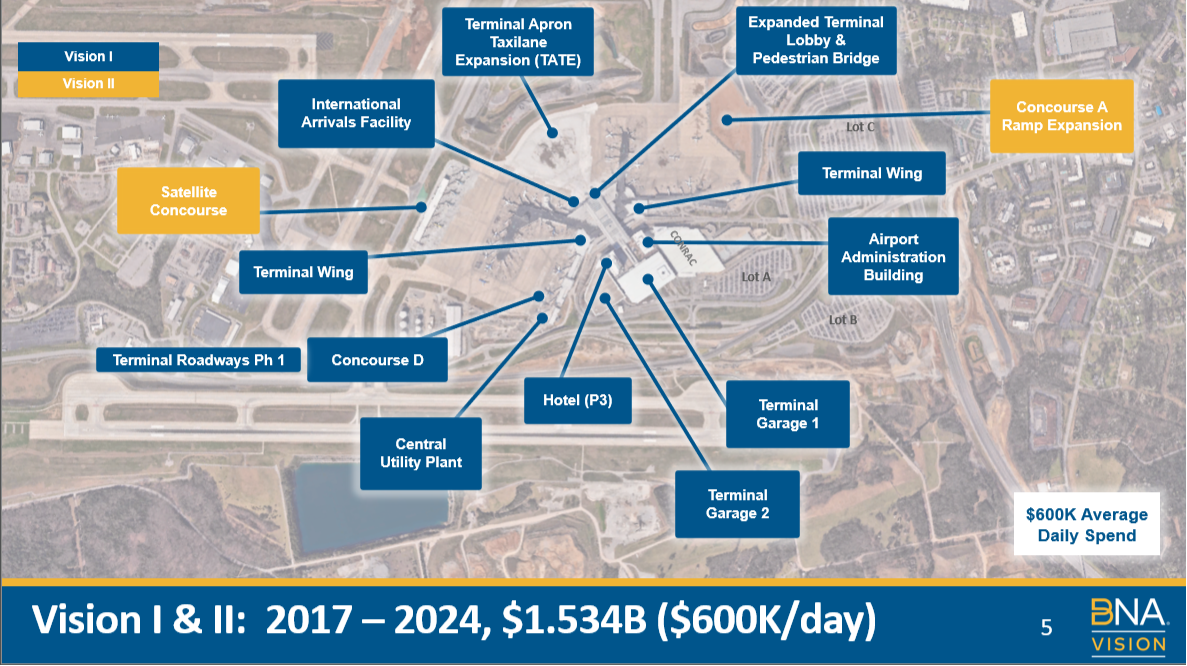
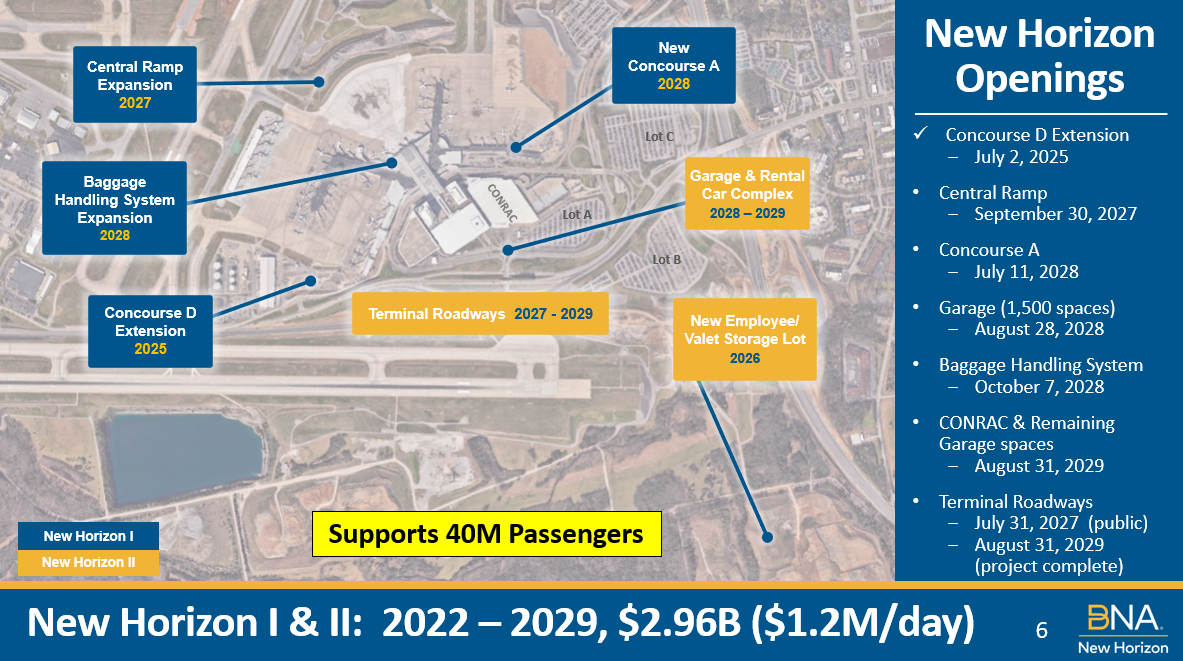
BNA Vision and New Horizon Capital Development Program
Team

Douglas E. Kreulen, A.A.E.

Adam Floyd, C.M.
-cropped.9vMKHrPJ.jpg)
Margaret M. Basrai, CPA, CGMA, C.M.

Robert L. Ramsey, P.E., A.A.E., IAP
Talk to us
Have questions? Reach out to us directly.